
Leveraging FEA Simulation Services for Superior Design Solutions

Updated: Aug 30
When it comes to engineering design, precision and reliability are non-negotiable. I have seen firsthand how Finite Element Analysis (FEA) simulation services transform the way products are developed, tested, and optimized. This powerful tool allows engineers to predict how a design will behave under real-world conditions without the need for costly physical prototypes. In this post, I will walk you through the essentials of FEA, its practical applications, and how partnering with a local fea analysis company can elevate your design process to new heights.
Understanding FEA Simulation Services and Their Impact
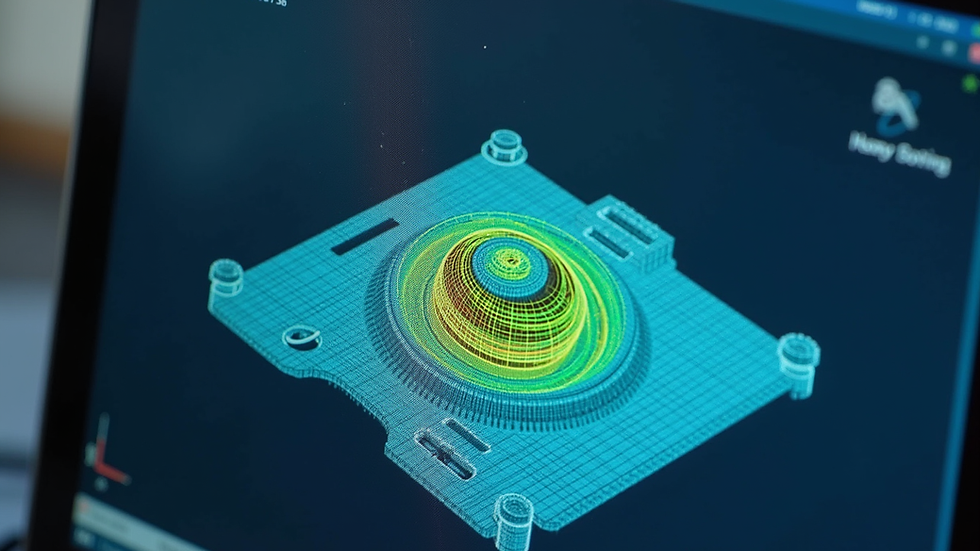
FEA simulation services use numerical methods to break down complex structures into smaller, manageable elements. By analyzing these elements, engineers can predict stress, strain, heat transfer, and other physical effects on the product. This process is invaluable for mechanical and industrial engineering projects where safety, durability, and efficiency are critical.
For example, imagine designing a new industrial valve. Instead of building multiple prototypes and testing them physically, FEA simulation can reveal weak points, potential failure modes, and areas where material can be saved. This not only reduces development time but also cuts costs significantly.
Some key benefits of FEA simulation services include:
Early detection of design flaws before manufacturing
Optimization of material usage to reduce weight and cost
Improved product safety by understanding stress distribution
Faster time-to-market through virtual testing and iteration
By integrating FEA into your design workflow, you gain a competitive edge that ensures your products meet stringent quality standards while staying within budget.
How to Choose the Right FEA Simulation Services for Your Project
Selecting the right FEA simulation service provider is crucial. You want a partner who understands your industry’s unique challenges and can tailor solutions accordingly. Here are some practical tips to guide your decision:
Evaluate Expertise and Experience
Look for companies with a proven track record in mechanical and industrial engineering. Their portfolio should include projects similar to yours, demonstrating their ability to handle complex simulations.
Check Software and Technology
The quality of FEA results depends heavily on the software used. Leading providers use advanced tools like ANSYS, Abaqus, or COMSOL Multiphysics, which offer robust capabilities for various simulation types.
Assess Communication and Support
Effective collaboration is key. Choose a service that offers clear communication, timely updates, and technical support throughout the project lifecycle.
Consider Local Presence
Working with a local fea analysis company can provide advantages such as easier coordination, faster turnaround times, and better understanding of regional industry standards.
Request Case Studies and References
Don’t hesitate to ask for examples of past work and client testimonials. This insight helps you gauge the provider’s reliability and quality of service.
By following these guidelines, you can ensure your investment in FEA simulation services delivers maximum value and supports your product development goals effectively.
Does NASA Use FEA?
Absolutely. NASA is one of the pioneers in adopting Finite Element Analysis for aerospace engineering. The agency relies heavily on FEA to design spacecraft, satellites, and launch vehicles that must withstand extreme conditions in space.
For instance, when developing the Mars rovers, NASA engineers used FEA to simulate the stresses and thermal loads the vehicles would encounter during launch, landing, and operation on the Martian surface. This virtual testing helped identify potential failure points and optimize the rover’s structure for durability and weight.
NASA’s use of FEA extends beyond spacecraft. It also applies to structural components of the International Space Station, propulsion systems, and even astronaut suits. The precision and predictive power of FEA enable NASA to innovate while maintaining the highest safety standards.
This example underscores how critical FEA simulation services are in industries where failure is not an option. It also highlights the technology’s versatility across different engineering disciplines.

Practical Applications of FEA in Mechanical and Industrial Engineering
FEA is not just for aerospace giants; it’s a game-changer for many sectors. Here are some practical ways FEA simulation services can be leveraged in mechanical and industrial engineering:
Automotive Industry: Engineers use FEA to analyze crashworthiness, optimize chassis design, and improve engine components. This leads to safer, lighter, and more fuel-efficient vehicles.
Manufacturing Equipment: FEA helps design robust machinery that can withstand repetitive loads and harsh environments, reducing downtime and maintenance costs.
Consumer Products: From household appliances to sports equipment, FEA ensures products are durable and perform as expected under various conditions.
Energy Sector: Wind turbine blades, pipelines, and pressure vessels are tested virtually to prevent failures and extend service life.
Construction and Infrastructure: Structural elements like beams, bridges, and supports are analyzed to meet safety codes and optimize material use.
In each case, FEA simulation services provide actionable insights that inform design decisions, improve product quality, and reduce risk. By simulating real-world conditions, engineers can innovate confidently and efficiently.
Maximizing ROI with FEA: Tips for Businesses
To get the most out of FEA simulation services, consider these actionable recommendations:
Integrate FEA Early in the Design Process
Don’t wait until the prototype stage. Early simulation helps catch issues before they become costly problems.
Define Clear Objectives
Know what you want to analyze—stress, thermal effects, vibration—and communicate this clearly to your FEA provider.
Use Accurate Material Data
The quality of simulation results depends on precise input data. Ensure material properties are well-characterized.
Iterate and Refine
Use simulation results to tweak your design iteratively. Each cycle brings you closer to an optimized solution.
Train Your Team
Equip your engineers with basic FEA knowledge to better interpret results and collaborate with simulation experts.
Leverage Local Expertise
Partnering with a local fea analysis company can streamline communication and provide tailored support aligned with your business needs.
By following these steps, businesses can reduce development costs, improve product performance, and accelerate time-to-market, all while minimizing risk.
Embracing the Future of Design with FEA Simulation Services
The engineering landscape is evolving rapidly, and FEA simulation services are at the forefront of this transformation. As computational power grows and software becomes more sophisticated, the possibilities for virtual testing and optimization expand.
Looking ahead, I believe that integrating FEA with emerging technologies like artificial intelligence and machine learning will unlock even greater potential. These advancements will enable predictive analytics, automated design optimization, and real-time simulation feedback.
For businesses aiming to stay competitive, embracing FEA is no longer optional. It is a strategic investment that drives innovation, enhances product quality, and ensures operational excellence.
If you are ready to take your design process to the next level, consider reaching out to a trusted local fea analysis company. Their expertise can help you harness the full power of FEA simulation services and turn your engineering challenges into opportunities for success.


Comments